
Dehumidifier vs tumble dryer vs heated airer — the cheapest way to dry clothes
How dehumidifiers, tumble dryers and heated airers compare for drying clothes in a UK home — running cost per load at current prices, speed, damp and upfront cost.
How to dry washing indoors with a dehumidifier without damp, how long it takes, the set-up that works best, and what size and features to look for.

Affiliate links: this guide contains Amazon links marked “paid link”. If you buy through them, Humidity Helper may earn a small commission at no extra cost to you. It never changes what we recommend. Read our disclosure.
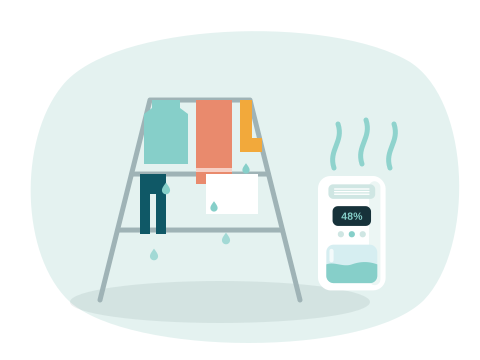
A compressor dehumidifier with a laundry mode dries a typical load indoors in roughly 4–8 hours. Put the airer and dehumidifier in a small room with the door and windows closed, leave a gap between clothes, and place the unit about a metre away. Choose 12L for occasional loads and 20L if you dry washing most days or for a family.
Drying washing indoors is unavoidable for a lot of UK households — no garden, no tumble dryer, or just the British weather from October to April. The problem is where the water goes. After a normal spin, clothes typically still hold roughly half their dry weight in water — so a 4–5kg load can carry around 2 litres or more. As it dries, all of that goes into the air, and without somewhere to go it ends up on your windows and walls. GOV.UK’s damp and mould guidance lists drying laundry alongside showering and cooking as everyday activities that build up moisture indoors.
A dehumidifier solves both problems at once. It dries the clothes faster and pulls that moisture out of the air before it becomes condensation.
Drying clothes on radiators is common, but it’s one of the worst options for damp. The moisture goes straight into the room, the clothes block the heat from reaching the room (so the boiler works harder), and the damp air drifts to colder rooms where it condenses. Many councils and housing associations specifically advise against it. If you’re comparing options on cost, see dehumidifier vs tumble dryer vs heated airer.
Usually 4–8 hours for a normal load. It depends on:
Many laundry modes run at full power for a set time (often around six hours) and then switch off, which makes overnight drying easy.
| How much you dry indoors | Suggested dehumidifier |
|---|---|
| 1–2 loads a week, 1–2 people | 12L compressor with laundry mode |
| 3–5 loads a week, or a family | 20L compressor with laundry mode |
| Daily loads for a large household | 20–25L compressor |
| Cold utility room or garage | Desiccant (its warm airflow helps drying) |
For more on capacity, see 10L vs 12L vs 20L, or answer six questions in the size calculator.
Best for most households
The simplest way to dry washing indoors without damp.
Compare options on Amazon (opens in a new tab)Paid link
Families and daily laundry
More space on the airer
A roomier airer often speeds drying more than a bigger dehumidifier.
Compare options on Amazon (opens in a new tab)Paid linkHow we choose: these are types of product matched to the criteria in this guide, not individually tested models. Check current specifications and reviews before you buy.
A compressor dehumidifier in laundry mode typically draws around 150–300W for a 12L model and more for a 20L. A five-hour session at 250W uses 1.25kWh — about 33p at the October–December 2026 price cap rate of 26.32p per kWh. Our running costs guide has a calculator for your own tariff.
If you dry washing indoors regularly, a cheap hygrometer on Amazon (opens in a new tab) (paid link) in the laundry room and a bedroom shows whether moisture is escaping. Readings creeping above 60% elsewhere usually mean the door is being left open, or the dehumidifier is too small for the amount of washing. Our guide to how to use a dehumidifier covers placement and settings in more detail.
Typically 4–8 hours for a normal load in a small closed room, depending on the fabric, how full the airer is, the room temperature and the size of the dehumidifier. Thick towels and jeans take longest; spreading items out makes the biggest difference.
Usually, yes, compared with vented and condenser tumble dryers, and it's similar to a heat pump dryer. A compressor dehumidifier drying a load over several hours typically uses around 1–2kWh. See our full comparison for the numbers.
Closed, along with the windows. The smaller and more enclosed the space, the faster the clothes dry and the less moisture spreads to colder rooms where it would condense.
Yes. Desiccant models blow slightly warm air, which helps in a cold room or unheated utility space. In a heated home a compressor model with laundry mode is cheaper to run.
It can. A spun load of washing can still hold a couple of litres of water, and it all goes into the air as it dries. Without a dehumidifier or good ventilation that moisture ends up on windows and cold walls, which can lead to condensation and mould.
How dehumidifiers, tumble dryers and heated airers compare for drying clothes in a UK home — running cost per load at current prices, speed, damp and upfront cost.
What the litre rating on a dehumidifier really means, and how 10L, 12L, 20L and 25L models compare on capacity, size, noise, tank and running cost in UK homes.
Where to place a dehumidifier, whether doors and windows should be open or closed, what humidity to set, and how long to run it for condensation, damp and laundry.