
Desiccant vs compressor dehumidifier — which is right for your home?
How desiccant and compressor dehumidifiers work, why room temperature matters so much in UK homes, and which type to buy for each room.
A plain-English guide to choosing a dehumidifier for a UK home — compressor or desiccant, the features worth paying for, and the marketing claims to ignore.

Affiliate links: this guide contains Amazon links marked “paid link”. If you buy through them, Humidity Helper may earn a small commission at no extra cost to you. It never changes what we recommend. Read our disclosure.
Choose the type by temperature — compressor for rooms above about 15°C, desiccant for cold rooms and outbuildings — then the size with our calculator. Prioritise a humidity setting, auto shut-off, a tank of 2 litres or more and a noise level you can live with; add laundry mode if you dry washing indoors. Ignore ioniser and "air purifying" claims.
Dehumidifier listings are full of numbers — litres per day, decibels, watts, square metres — and most of them are measured in conditions nothing like a British home in November. This guide cuts through it in four decisions.
If your windows are wet most mornings, mould keeps coming back, or a hygrometer reads over 60% most of the day, then yes. If the problem is a single wet patch that worsens after rain, it’s probably a leak or structural damp instead — see how to tell condensation from damp. Not sure? Start with the signs you need a dehumidifier.
For a wardrobe, cupboard or car, a moisture absorber may be enough.
This depends mainly on how warm the room will be when you use it.
Our full comparison is in desiccant vs compressor dehumidifiers.
Dehumidifiers are sized by how many litres of water they can remove per day in test conditions. As a rough guide, 10–12 litres suits a room or small flat, 12–20 litres a family home, and 20 litres or more serious damp or daily indoor laundry.
For a recommendation based on your own home — size, temperature, laundry and how bad the problem is — use our dehumidifier size calculator. To understand the trade-offs between capacity classes (price, weight, noise, tank size), see 10L vs 12L vs 20L dehumidifiers.
Worth paying for:
Nice to have:
Usually not worth paying extra for:
A 10–12 litre compressor model typically uses 150–250W — roughly 4–7p an hour at the October–December 2026 price cap rate of 26.32p per kWh. Desiccant models typically use 300–650W. Our running costs guide has a calculator for your own tariff.
Rooms and small flats
Drying clothes indoors
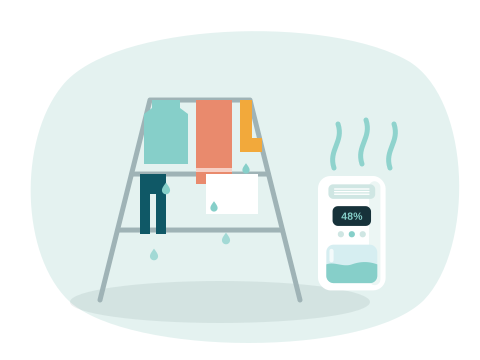
Place it next to the airer in a small room with the door closed.
Compare options on Amazon (opens in a new tab)Paid linkFamily homes and serious damp
Cold homes and garages
How we choose: these are types of product matched to the criteria in this guide, not individually tested models. Check current specifications and reviews before you buy.
A humidistat — a humidity setting that lets the unit switch itself off when the room reaches your target (around 50%). It saves electricity, stops the room getting too dry and means you don't have to keep switching it on and off.
If you dry clothes indoors regularly, yes. Laundry mode runs the fan and compressor at full power, often with a wider airflow, to dry washing faster. It's usually much cheaper than a tumble dryer and dries the room at the same time.
Many models have a continuous drainage outlet so you can run a hose to a sink or drain. That's useful in a utility room, cellar or garage, but less practical in a bedroom or living room.
No. App control is handy for checking humidity remotely or scheduling, but a good humidistat does the important job on its own. Pay for it only if you'll genuinely use it.
Rather than recommending brands, we suggest comparing the things that affect performance in your home — type, rated extraction and the conditions it was measured in, noise level, warranty and the availability of spare filters. A well-specified model from an established brand with good UK customer service is usually the safest choice.
How desiccant and compressor dehumidifiers work, why room temperature matters so much in UK homes, and which type to buy for each room.
What the litre rating on a dehumidifier really means, and how 10L, 12L, 20L and 25L models compare on capacity, size, noise, tank and running cost in UK homes.

The clear signs your home is too humid — from streaming windows to musty wardrobes — how to confirm it with a hygrometer, and when a dehumidifier isn't the answer.